
India’s stock market has become a significant tool for wealth creation for the middle class, especially over the past few years. Historically, many Indian households favored traditional investments like fixed deposits (FDs), gold, or real estate for their savings, seeing equities as a risky venture. However, from 2019 to 2024, the Indian stock market, led by key indices like the Sensex and Nifty 50, has delivered impressive returns, shifting perceptions. The rise of digital platforms and increased financial literacy has further democratized access to equities, making stock market investing a key avenue for long-term wealth creation. In this post, we will explore how the stock market has contributed to middle-class wealth creation through market performance, retail participation, mutual funds, and more.
Robust Stock Market Performance (2019–2024)
Over the last five years, Indian equity markets have rewarded investors with solid returns. The Sensex and Nifty 50 indices have nearly doubled, reflecting an approximate 15% annualized return. Notably, mid-cap stocks outperformed large-caps, with mid-cap indices delivering returns upwards of 30% annually during the same period.
To put it in perspective, an investment of ₹1 lakh in the Sensex index fund in 2019 would have grown to approximately ₹1.9 lakh by 2024, while the same investment in a fixed deposit might only amount to ₹1.3–1.4 lakh. The equity market has far outpaced traditional savings instruments like FDs, making stocks a highly attractive option for wealth-building.
Even during periods of market volatility, such as the 2020 crash, the stock market showed resilience, bouncing back to new highs and rewarding long-term investors. This consistent growth has made equity investing an appealing alternative to lower-return savings methods like FDs and Public Provident Fund (PPF).
Surge in Retail Participation in Stocks
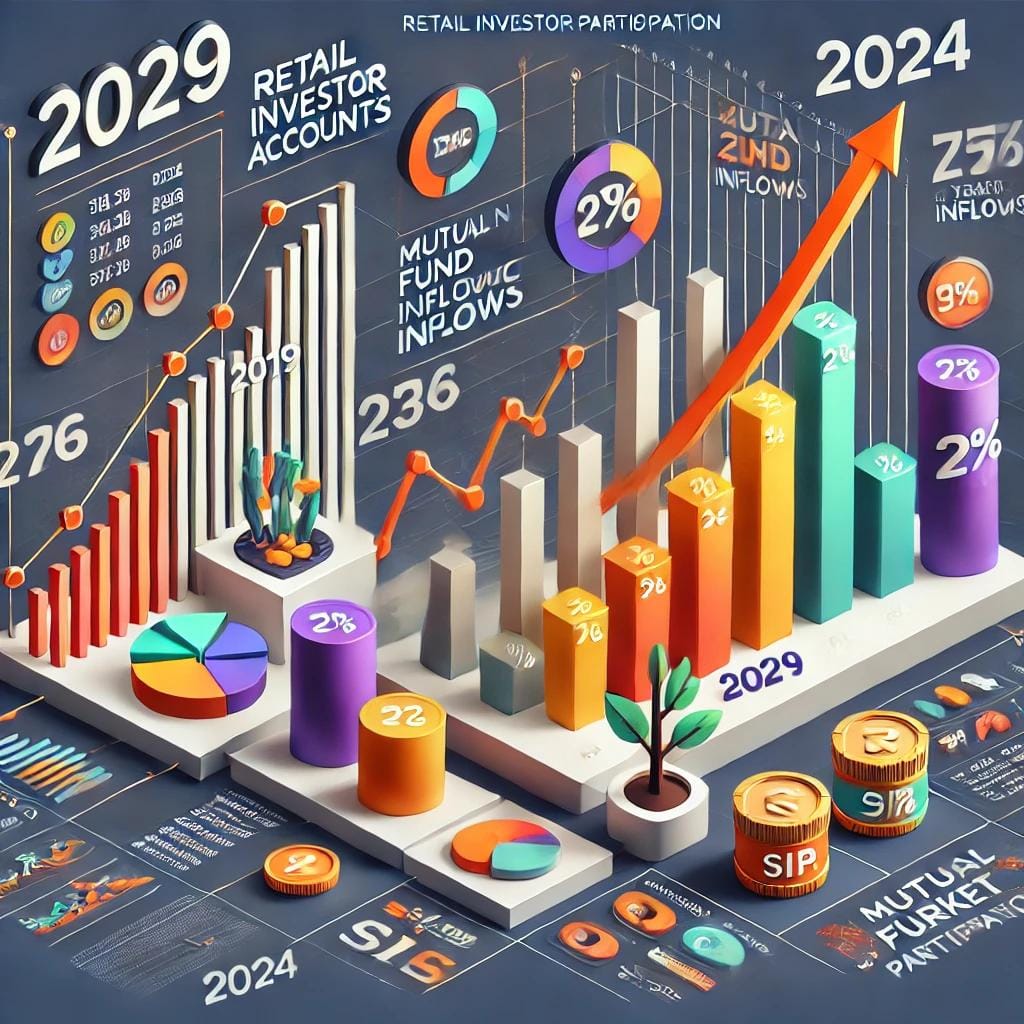
One of the most remarkable changes from 2019 to 2024 is the surge in retail participation. The number of demat accounts—accounts needed to hold stocks—has increased dramatically, from around 39 million in 2019 to over 185 million by 2024. This surge indicates that more people, particularly from the middle class, are entering the stock market.
Several factors have fueled this increase:
- Digital platforms: Trading apps and online brokerage firms have made investing in stocks easier and more accessible, especially for people in smaller towns. These platforms allow investors to open accounts within minutes and start trading with small amounts.
- Stock market performance: As the equity markets delivered strong returns, more people began to view stocks as a viable investment vehicle. What was once perceived as a risky pursuit is now seen as a reliable long-term wealth creation strategy.
- Regulatory improvements: Simplified processes for account opening and trading have also played a significant role. Investors can now easily access stock markets with greater confidence in the safety and transparency of their investments.
These developments have led to millions of new investors joining the market, signaling a broader acceptance of stock market participation across all segments of society, including smaller cities and towns.
The Rise of Mutual Funds and SIPs
In parallel with the boom in direct stock trading, mutual funds have seen a significant rise in popularity. Particularly, Systematic Investment Plans (SIPs) have become a key tool for middle-class investors to participate in the stock market. SIPs allow investors to contribute small, fixed amounts regularly into mutual funds, making it easier to manage risk and stay invested for the long term.
In the past five years, SIP inflows have risen sharply, with monthly contributions growing from ₹8,100 crore in 2019 to ₹20,300 crore by 2024. This growth indicates that more people are adopting SIP strategies to take advantage of equity market returns, which consistently outperform traditional savings instruments.
Additionally, mutual fund folios—or investor accounts—have doubled, from around 8.3 crore in 2019 to 18.1 crore in 2024. This reflects the increasing trust in professional money management and the willingness of Indian investors to embrace diversified, risk-adjusted returns via mutual funds. The growing preference for mutual funds over direct stock picking highlights a shift toward professional fund management and diversified investing.
There are few ai tools which can help you to save and even budget your finances . Read our blog for more click here
Equities vs. Traditional Saving Options
To better understand the stock market’s role in wealth creation, it’s crucial to compare it to traditional saving methods like fixed deposits, gold, and PPF.
- Fixed Deposits: Though safe, FDs offer interest rates of only 5-6% per annum, with the rate having dipped even lower in recent years. An investment of ₹1 lakh in an FD yielding 6% would grow to ₹1.34 lakh in five years, whereas a similar investment in stocks could have nearly doubled.
- PPF: PPF, which offers government-backed security, has interest rates of around 7.1%, growing ₹1 lakh to approximately ₹1.42 lakh in five years. Though stable, it still trails behind stock market returns.
- Gold: Gold, another popular asset, saw solid returns, especially during times of economic uncertainty, but still lags behind equities in the long run, delivering about 12% annual growth compared to 18–30% for stocks.
The performance of the Indian stock market—which consistently outpaced FDs, PPF, and gold—makes a compelling case for middle-class investors to consider equities as a primary tool for wealth-building. Equities have proven to be one of the most effective ways to achieve financial growth, especially for long-term goals like retirement and children’s education.
Behavioral Shifts and Financial Literacy
The rise in stock market participation is not only a result of better access to platforms but also reflects a deeper behavioral shift. More middle-class investors are adopting a long-term investment mindset, focusing on building wealth through consistent, disciplined investing.
- SIP adoption: Many new investors are now committed to monthly SIPs, which help them stay invested through market ups and downs. This shift towards patience and long-term thinking is a significant behavioral change from the past, when many investors tried to time the market or make quick profits.
- Financial literacy: As financial education spreads, people are becoming more aware of the benefits of diversifying their investments. Mutual funds, index funds, and ETFs are gaining popularity as they provide professional management and reduce the risks associated with picking individual stocks.
- Digital platforms: With easier access to information and financial tools, even first-time investors are making informed decisions. More people are realizing that equity investments can offer better returns compared to traditional methods like FDs or gold.
The growth in financial literacy, combined with the rise of digital platforms, has allowed the Indian middle class to take control of their financial futures, becoming smarter investors over time.
Conclusion: Embracing Equities for Long-Term Wealth
In conclusion, the Indian stock market has proven itself as a powerful tool for middle-class wealth creation over the past five years. With impressive returns from both large-cap and mid-cap stocks, an explosion in retail investor participation, the rise of SIPs, and a shift in investment behavior, the stock market is now a key avenue for long-term wealth creation. Equities, through mutual funds or direct investments, have consistently outperformed traditional savings methods, making them an attractive option for middle-class families looking to build financial security.
The opportunities for growth through the stock market are vast, and with continued improvements in access, financial education, and regulatory support, the Indian stock market can help propel millions of middle-class households toward prosperity in the coming years. By embracing a long-term, disciplined investment strategy, the middle class has a unique opportunity to build sustainable wealth and secure a better financial future for themselves and future generations.
The stock market is no longer just for the elite. It’s an opportunity for every middle-class investor in India to grow their wealth and be a part of the nation’s financial success story.
for more you can visit here